
State of California Department of Justice
Rob Bonta
Attorney General
Attorney General
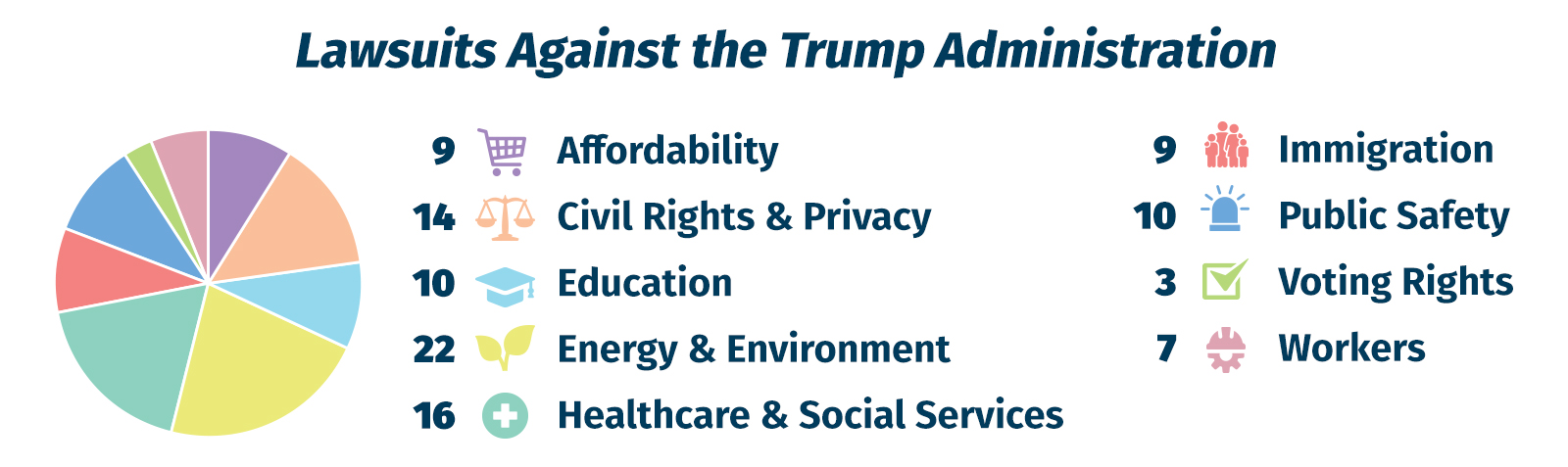
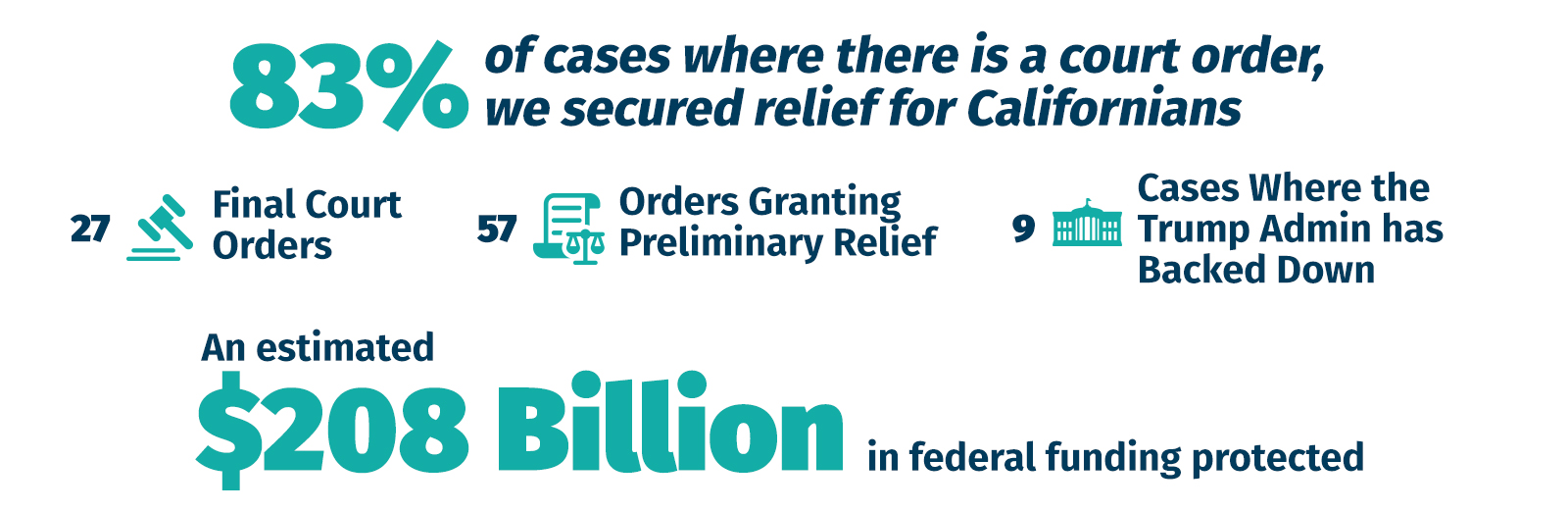
Since President Trump returned to office, California and our shared values have been under constant threat — and the California Department of Justice has led the way in fighting back, filing 100 lawsuits to protect California’s people, values, and resources.
California DOJ provides annual reports to the Legislature on the status of federal accountability legislation.
To learn more about all of the federal accountability actions California has taken, including amicus briefs, please visit oag.ca.gov/federal-accountability
DOGE Treasury Access: New York v. Donald J. Trump (No. 25-cv-01144)
California filed a lawsuit challenging the Trump Administration’s decision to expand access to data maintained by the Treasury Department’s Bureau of the Fiscal Service. In the lawsuit, 19 attorneys general argue that this executive action has allowed people associated with the Department of Government Efficiency (DOGE) to access Americans’ personal and private information, including bank account and social security numbers.
Tariffs 1.0: California v. Trump, (No. 25-cv-03372)
California filed a lawsuit challenging President Trump’s unlawful use of power to impose tariffs and direct the Department of Homeland Security (DHS) and Customs and Border Patrol (CPB) to implement and enforce those tariffs without the consent of Congress. In the lawsuit, Attorney General Bonta and Governor Newsom challenged the President’s use of the International Emergency Economic Powers Act of 1977 (IEEPA) to levy those tariffs, arguing that the IEEPA does not authorize the President to impose these tariffs.
California and a multistate coalition filed a lawsuit challenging the Trump Administration’s funding restrictions on the Continuum of Care (CoC) grant program. Seeking to implement President Trump’s “Ending Crime and Disorder on America’s Streets” Executive Order, the U.S. Department of Housing and Urban Development (HUD) announced on November 13 that it would impose new restrictions on CoC funding, including placing limits on funding for permanent housing projects, restricting the services available for people with mental disabilities and substance use disorders, and discriminating against localities whose approach to homelessness differs from the Administration.
CFPB Defunding: State of New York v. Vought (No. 25-cv-02384)
California co-led a coalition of 22 attorneys general in filing a lawsuit challenging the Consumer Financial Protection Bureau’s (CFPB) Acting Director’s unlawful decision not to fund the agency’s operations, preventing it from performing legally mandated functions. The lawsuit, filed in the U.S. District Court for the District of Oregon, challenges the decision by CFPB Acting Director Russell Vought to refuse to request the necessary funding for the agency from the Federal Reserve, in violation of the Dodd-Frank Wall Street Reform and Consumer Protection Act.
Tariffs 2.0: Oregon v. Trump (Case 1:26-cv-01472)
California along with a coalition of 22 attorneys general and the states of Kentucky and Pennsylvania, filed a lawsuit challenging President Trump’s imposition of global tariffs using Section 122 of the Trade Act of 1974. The lawsuit argues that the President’s use of Section 122 to impose tariffs is illegal because the President’s justifications for its use do not fall within the limited circumstances required by the statute.
As part of a coalition of 21 attorneys general and two governors, Attorney General Bonta filed a lawsuit challenging HUD Fiscal Year 2026 Notice of Funding Opportunity (NOFO) for the CoC program. CoC is the federal government’s flagship program for funding affordable housing and other services for individuals at risk of and experiencing homelessness.
Tariffs 3.0: Oregon v. Donald J. Trump (No. 1:26-cv-03467)
California co-led a coalition of 25 states in filing a lawsuit against the Trump Administration challenging its new efforts to impose illegal tariffs on American consumers and businesses. The lawsuit, filed in the U.S. Court of International Trade, challenges the Administration’s recent decision to impose tariffs on over 80 countries (the European Union and nearly 60 other countries), countries that together account for 99.4% of all U.S. imports — costs that will be passed along to Americans already struggling with affordability.
OCC Escrow Rule: Oregon v. Office of the Comptroller of the Currency (No. 3:26-cv-01672)
California, as part of a coalition of 10 attorneys general, filed a lawsuit to block the Trump Administration’s latest effort to favor big business over working families. The lawsuit, filed in the U.S. District Court for the District of Oregon, challenges two rules by the Office of the Comptroller of the Currency (OCC) that invalidate state laws requiring mortgage lenders to pay interest on the money they require borrowers to deposit into escrow accounts to cover taxes and insurance.
CAFE Standards: California v. National Highway Traffic Safety Administration (No. 25-1595)
California led a coalition of 26 states, counties, and cities in filing a lawsuit against the National Highway Traffic Safety Administration (NHTSA) challenging its final rule weakening corporate average fuel economy (CAFE) standards for new passenger cars and light trucks. Historically, NHTSA’s standards have reduced consumer costs by improving fuel efficiency for vehicles, placed downward pressure on gas prices by reducing fuel consumption, protected the U.S. economy from global oil shocks, and reduced pollution from tailpipes and refineries.
California, co-leading a coalition of 19 attorneys general, filed a lawsuit challenging the U.S. Department of Education’s efforts to withhold federal funding from state and local agencies that refuse to abandon lawful programs and policies that promote equal access to education in K-12 classrooms across the nation. On April 3, 2025, the Department of Education informed state and local agencies that they must accept the Trump Administration’s new and legally incoherent interpretation of Title VI of the Civil Rights Act of 1964 with respect to diversity, equity, and inclusion efforts—or else risk immediate and catastrophic loss of federal education funds. California, like many other states, refused to certify its compliance with these new requirements, explaining that there is no lawful or practical way to do so given the Department’s vague, contradictory, and unsupported interpretation of Title VI.
Transgender Student Athletes: California v. United States Department of Justice (No. 3:25-cv-04863)
California filed a pre-enforcement lawsuit against the U.S. Department of Justice (U.S. DOJ) in anticipation of imminent legal retaliation against California’s school systems. In the lawsuit, Attorney General Bonta asks the U.S. District Court for the Northern District of California to uphold California’s anti-discrimination law and prevent the Trump Administration from taking retaliatory action, such as withholding or conditioning federal funding, over the state’s refusal to comply with U.S. DOJ’s unlawful demands.
California sued the Trump Administration over its improper use of a single subclause buried in federal regulations promulgated by the Office of Management of Budget (OMB) to terminate tens of billions of dollars in grant funding to the states. Since taking office, the Trump Administration has engaged in a nationwide slash-and-burn campaign, unlawfully justifying the termination of tens of billions of dollars in critical federal funding appropriated by Congress and awarded to the states. Attorney General Bonta and a multistate coalition argue that the Administration is not allowed to terminate grants based on agency priorities that were set or changed only after a grant was originally awarded.
Medicaid Data Disclosure: California v. Department of Health and Human Services (No. 3:25-cv-05536)
California led a multistate coalition in challenging the Department of Health and Human Services’ unsupported decision to provide the Department of Homeland Security unfettered access to individual personal health data. The transfer of data to the Department of Homeland Security created fear and confusion that will lead noncitizens and their family members to disenroll, or refuse to enroll, in emergency Medicaid for which they are otherwise eligible, leaving states and their safety net hospitals to foot the bill for federally mandated emergency healthcare services.
SNAP Data: California v. Department of Agriculture (No. 3:25-cv-06310)
California led a multistate lawsuit challenging the U.S. Department of Agriculture’s (USDA) demand that states turn over personal and sensitive information about millions of Supplemental Nutrition Assistance Program (SNAP) recipients. SNAP applicants provide their private information on the understanding, backed by long standing state and federal laws, that their information will not be used for unrelated purposes. USDA threatened to withhold administrative funding for the program if states fail to comply, effectively forcing states to choose between protecting their residents’ privacy and providing critical nutrition assistance to those in need.
In this case, California co-led litigation challenging new conditions in the U.S. Department of Health and Human Services’ (HHS) Grants Policy Statement and other grant documents that attempt to require HHS grant recipients to comply with President Trump’s executive order targeting transgender, nonbinary, intersex, and gender nonconforming individuals.
Fair Housing Act Guidance: Illinois v. Department of Housing & Urban Dev. (No. 3:26-cv-02262)
California co-led a multistate coalition against HUD over guidance it issued that significantly weakens fair housing protections and makes it harder to hold landlords accountable for discrimination. The Fair Housing Act establishes a floor — not a ceiling — for protection against housing discrimination, meaning that states can expand the scope of protections beyond what the Fair Housing Act mandates and many states have chosen to do so. HUD issued guidance in September 2025 threatening to decertify state housing agencies — thereby cutting off complaint referrals and funding — if they consider protections other than those required by the Fair Housing Act, while simultaneously imposing new unlawful funding conditions.
USDA Grant Terms and Conditions: Massachusetts v. Department of Agric. (No. 1:26-cv-11396)
California co-led a multistate lawsuit challenging the Trump Administration’s attempt to impose new discriminatory conditions on USDA grants that provide school lunches, SNAP funding, and other essential programs. The conditions would require federal funding recipients to comply with vague and unrelated policies on immigration, gender ideology, transgender athletes, and diversity, equity, and inclusion. The conditions violate both the U.S. Constitution by exceeding USDA’s statutory authority, attaching vague conditions to funding, failing to provide a reasoned explanation or follow procedural requirements, and threatening billions of dollars in critical funding.
Federal Contractors Executive Order: Maryland v. Hegseth (No. 1:26-cv-02322)
California co-led a lawsuit against the federal administration over the implementation of an Executive Order that requires the addition of new terms to federal contracts that — in the name of purging “diversity, equity, and inclusion” — impose unclear and confusing requirements on federal contractors and subcontractors. These terms depart from anti-discrimination policies that contractors have followed for many decades. The federal Administration is also threatening severe penalties on federal contractors that do not comply yet fail to provide adequate notice of what is prohibited.
TANF Data: New York v. Administration for Children and Families
California filed a lawsuit challenging the Trump Administration’s latest attempt to weaponize sensitive personal information about California families and children. The Trump Administration issued a Systems of Records Notice (SORN) relating to the administration of the Temporary Assistance for Needy Families (TANF) program, which provides states with billions of dollars each year to keep families out of poverty. The SORN purports to dramatically broaden the federal government’s role in overseeing TANF and authorize the wholesale sharing of TANF recipients’ most sensitive personal information with any federal, state, or private entity it wishes, including DHS.
Commercial Driver Data: Illinois v. Department of Transportation (No. 1:26-cv-02547)
California joined a multistate coalition in filing a lawsuit challenging the Federal Motor Carrier Safety Administration’s (FMCSA) attempt to obtain the sensitive personal information of millions of drivers who have either a commercial driver’s license or commercial driver’s permit required to drive large, heavy, or hazardous commercial vehicles. This sensitive information includes drivers’ names, license numbers, licensing states, and more. In the lawsuit, the coalition argues that the demand for this data exceeds FMCSA’s authority, is barred by the federal Drivers Privacy Protection Act, and is barred by the protections of the federal Privacy Act.
Commercial Driver Data: Illinois v. Department of Homeland Security (No. 1:26-mc-00019)
This lawsuit challenges the Department of Homeland Security’s attempt, in coordination with the Federal Motor Carrier Safety Administration, to obtain via subpoena the sensitive personal information of millions of drivers who have either a commercial driver’s license or commercial driver’s permit required to drive large, heavy, or hazardous commercial vehicles. California and a multistate coalition argue that this broad demand for information is another example of federal overreach that weaponizes the personal data of specialized commercial drivers and runs afoul of the law.
Impoundments: California v. Trump (No. 3:26-cv-11185)
California, leading a multistate coalition, filed a lawsuit challenging the Trump Administration’s unlawful attempt to impound Congressionally appropriated federal funding that is crucial for states and their residents. This is the latest front in a multi-year campaign of failed attempts by the Trump Administration to stop, terminate, withdraw, or condition funding to states supporting policies Congress has chosen to fund but with which the President disagrees. In the lawsuit, Attorney General Bonta and the coalition argue that the impoundment of federal funding, including the President’s recently announced, “pocket rescission,” violates the U.S. Constitution and the Administrative Procedure Act.
California filed a lawsuit challenging the National Archives and Records Administration’s abrupt decision to close the National Archives at San Francisco and transfer its holdings to other National Archives facilities across the country. The San Francisco National Archives holds records that tell the story of Northern and Central California’s history, with records dating back more than 175 years. In the lawsuit, Attorney General Bonta argues that the decision to close this facility, without regard for those who rely on it, violates the Administrative Procedure Act and should be blocked.
Teacher Prep Grants: California v. Department of Education (No. 25-cv-10548)
California, leading a multistate coalition, filed a lawsuit challenging the Trump Administration’s unlawful termination of grant funding for K-12 teacher preparation programs. Beginning on February 7, 2025, California institutions received letters purporting to terminate grants with a total value of at least $148 million in critical funding to address the state’s ongoing teacher shortage through teacher preparation programs. These programs are designed to create a pipeline for teachers serving rural and urban communities and teaching harder-to-fill positions like math and science and have been shown to increase teacher retention rates and ensure that educators remain in the profession beyond the crucial first five years.
Education Stabilization Funding: New York v. Department of Education (No. 25-cv-02990)
This case challenges the Department of Education’s unlawful rescission of prior agency actions that preserved States’ access to hundreds of millions of dollars in funding currently being used by school districts to support the academic recovery of students following the COVID-19 pandemic. In California alone, over $200 million in previously awarded and obligated funding is at stake — funding that school districts use for afterschool and summer learning programs, the purchase of educational technology, and the provision of mental health services and support.
Mental Health Grants 1.0: Washington v. Department of Education (No. 25-cv-01228)
This case challenges the Department of Education’s termination of grants awarded through congressionally established school mental health funding programs, including roughly $200 million awarded to 44 local education agencies, county offices of education, and universities in California. The grants have helped schools hire hundreds of psychologists, counselors, and social workers who have served thousands of students, including in the State’s most economically disadvantaged and rural communities. The Department of Education awarded this funding to the nation’s high-need, low-income, and rural schools pursuant to its Mental Health Service Professional Demonstration Grant Program and its School-Based Mental Health Services Grant Program.
Education Formula Funding: State of California v. McMahon (No. 1:25-cv-00329)
In partnership with 23 states and two governors, California co-led this action challenging the Department of Education’s funding freeze to six longstanding education programs. Impacted programs included education for migrant children and English learners; programs that promote effective classroom instruction, improve school conditions and the use of technology in the classroom; community learning centers that offer students a broad range of opportunities for academic and extracurricular enrichment; and adult education and workforce development efforts. In California, hundreds of millions of dollars in federal education funding was frozen.
Public Service Loan Forgiveness: Piedade Da Silva v. Hyde (No. 1:25-cv-13266)
California co-led a coalition of 22 attorneys general in filing a lawsuit challenging new Department of Education regulations that could exclude people with federal student loans from Public Service Loan Forgiveness (PSLF) eligibility based on whether their employers engage in actions that the Trump Administration deems to have a “substantial illegal purpose.” The rule threatens PSLF eligibility for organizations that are engaged in important and legal activities, such as providing legal services to immigrants, providing gender-affirming care to minors, participating in diversity, equity, and inclusion initiatives, or engaging in civil protest and the right to assembly. As of 2024, more than 81,000 Californians have received over $6 billion in PSLF forgiveness.
Transgender Youth Educational & Privacy Rights: California v. Department of Educ., No. 3:26-cv-01259
This lawsuit challenges the Department of Education’s findings that the California Department of Education (CDE) “facilitated and promoted the adoption of policies and practices that violate” the Family Educational Rights and Privacy Act (FERPA). The Trump Administration demanded that CDE take “corrective actions” not required by FERPA, including permitting California local educational agencies to adopt parental notification policies that may forcibly “out” transgender students. In the lawsuit, California argues that it is in substantial compliance with FERPA, and that U.S. ED’s findings are an unconstitutional attempt to impose new conditions on $4.9 billion in federal education funding.
IPEDS Data Reporting: Massachusetts v. Department of Education (No. 1:26-cv-11229)
In this case, California co-led a multistate coalition challenging the Administration’s burdensome new requirements that colleges and universities submit data linking race to admissions, financial aid, and student performance. While the Administration claims to be seeking this data to assist it in enforcing Title VI of the Civil Rights Act of 1964, which prohibits discrimination based on race, its unprecedented new demands make it all but impossible for colleges and universities to submit usable data for review.
Professional Degree Loan Limits: Maryland v. Department of Educ. (No. 1:26-cv-01957)
This case challenges the Department of Education’s final rule that narrows the federal definition of a “professional degree” and would dramatically reduce the availability of federal student loans for students seeking graduate degrees in nursing, physician assistant studies, physical therapy, and other professions. This change would make it harder for these vital healthcare workers to pursue advanced degrees, threatening the availability of a critical workforce as well as the operations of healthcare systems in California and across the country.
Special Education Grant Funding: California v. Department of Educ. (No. 3:26-cv-05549)
In this case, California is leading a multistate lawsuit challenging the Department of Education’s discontinuation of awarded grants under the State Personnel Development Grant (SPDG) program. These competitive grants provide critical funding for the professional development of special education staff and support services for children with disabilities. In California, more than 880,000 students are eligible for special education services. Although the California Department of Education had been awarded a five-year SPDG grant in 2022, the Department of Education discontinued the grant in September 2025 because of conclusory, baseless concerns about equity-related initiatives.
Mental Health Grants 2.0: Washington v. Department of Education (No. 2:26-cv-02409)
This is a multistate case challenging the Department of Education’s further termination of grants awarded through congressionally established school mental health funding programs, including roughly $200 million awarded to 44 local education agencies, county offices of education, and universities in California. The grants have helped schools hire hundreds of psychologists, counselors, and social workers who have served thousands of students, including in the State’s most economically disadvantaged and rural communities. After Attorney General Bonta and a coalition of attorneys general successfully blocked the Department’s earlier effort to discontinue these grants, the Department announced a new plan to end the funding under a different regulation, prompting this lawsuit.
Offshore Wind Energy: New York v. Trump (No. 25-cv-11221)
A coalition of states with particular interest in the development of offshore wind energy, including California, filed this litigation challenging the federal government’s efforts to freeze development of offshore wind energy. Offshore wind projects support hundreds of thousands of jobs, create billions of dollars in economic activity and tax payments, and already supply more than 10% of the country’s electricity. California has five federal offshore wind leases: two are located offshore by Humboldt, while the remaining three are offshore from Morro Bay. These new developments are designed to bring substantial amounts of clean energy to the grid, including enough to power 1.6 million homes.
This action challenged the Federal Highway Administration’s unlawful directive to withhold billions of dollars in funding approved by bipartisan majorities in Congress for electric vehicle charging infrastructure that would reduce planet-warming pollution, expand access to clean vehicles, and create thousands of green jobs. Specifically, in California, FHWA’s unlawful actions would cost the state more than $300 million, eliminate thousands of good-paying jobs, and dismantle a critical, emerging tech industry.
National Energy Emergency/Clean Water Act Permits: Washington v. Trump (No. 25-cv-00869)
This litigation challenges President Trump’s “energy emergency” executive order, together with the Army Corps of Engineers’ and the Advisory Council on Historic Preservation’s actions pursuant to that order. Although national energy production reached an all-time high under President Biden and has continued growing, President Trump unlawfully invoked authority under the National Emergencies Act to improperly declare a national energy emergency.
This case challenges the unprecedented and unlawful use of the Congressional Review Act to upend California’s clean vehicles program, specifically the Advanced Clean Cars II, Omnibus, and Advanced Clean Trucks standards. If California is prevented from enforcing these vehicle emission standards, it will result in the loss of significant economic and public health benefits, costing California taxpayers an estimated $45 billion in preventable health care costs. Losing these standards would also undermine market certainty for vehicle manufacturers, stifling innovation and job creation, including in the electric vehicle sector, which has been a growing source of high-paying green jobs and investment.
DOE Indirect Cost Cap: New York v. Department of Energy (No. 625-cv-01458)
California joined a multistate coalition of 18 attorneys general and two governors in suing to block the U.S. Department of Energy (DOE) from imposing a new funding cap that slashes support for vital state-run energy programs. DOE policy would unlawfully deny states critical funds by limiting reimbursement for key administrative and staffing costs that have long been covered by federal energy programs. The coalition argues that by capping certain funding for these programs, DOE is jeopardizing states’ ability to keep them running.
California, the California Public Utilities Commission (CPUC), and a multistate coalition challenges the Environmental Protection Agency’s (EPA) unlawful termination of the $7 billion Solar for All Program. EPA’s termination of the program denies states critical funding for solar energy in low-income and disadvantaged communities. In this lawsuit, the coalition argues that the EPA’s abrupt termination of the Solar for All Program breached its contractual obligations to the states and seeks money damages.
Solar For All Funding, District Court: Arizona v. Environmental Protection Agency (No.2:25-cv-2015)
This case is a parallel case to Maryland Clean Energy Ctr. v. United States, filed in the U.S. District Court for the Western District of Washington. In this case, the multistate coalition allege that the Trump Administration violated federal laws, including the Administrative Procedure Act and the U.S. Constitution, by terminating Solar for All funds — and asks the court to declare the termination unlawful and order EPA to reinstate the program.
This litigation, co-led by California, challenges the Trump Administration’s suspension of two bipartisan grant programs for electric vehicle charging infrastructure that would reduce pollution, expand access to clean vehicles, and create thousands of green jobs. Without any explanation or notice, the U.S. Department of Transportation refused to approve any new funding under two electric vehicle charging infrastructure programs created in the Infrastructure Investment & Jobs Act: the Charging and Fueling Infrastructure Program and the Electric Vehicle Charger Reliability and Accessibility Accelerator Program.
Sable Pipeline – Defense Production Act: California v. Wright (No. 2:26-cv-3396)
California filed a lawsuit against the Trump Administration challenging the U.S. Department of Energy Secretary Chris Wright’s “Pipeline Capacity Prioritization and Allocation Order” (Order) seeking to halt its use as the basis for Sable Offshore Corp.’s (Sable) unlawful restart of two California onshore oil pipelines that are subject to State regulation and oversight. The Order, issued under the Defense Production Act, unlawfully purports to supersede state law, state court orders, and a federal court-approved Consent Decree to allow Sable to restart oil transport through lines CA-324 and CA-325, also known as the Las Flores Pipelines.
California filed a lawsuit against the Trump Administration challenging the Pipeline and Hazardous Materials Safety Administration’s (PHMSA) attempt to evade state regulation through its orders to federalize the Las Flores Pipelines, approve Sable’s Restart Plan, and issue Sable an emergency permit to restart oil transport through the pipelines. In the lawsuit, Attorney General Bonta and the Office of the State Fire Marshal argue that PHMSA's orders violate the Administrative Procedure Act and ask the Court to overturn PHMSA’s illegal orders.
California filed a second petition against the Trump Administration challenging PHMSA’s recent issuance of a new “non-emergency special permit” Sable to transport oil through the Las Flores pipelines in Santa Barbara, San Luis Obispo, and Kern counties. In the lawsuit, Attorney General Bonta and the Office of the State Fire Marshal challenge PHMSA’s issuance of the new permit as unlawful.
DOE Funding Disruptions: California v. Wright (No. 3:26-cv-01417)
California co-led a multistate coalition challenging the Trump Administration’s unlawful decision to terminate funding for congressionally mandated energy and infrastructure programs created by laws such as the Inflation Reduction Act and the Infrastructure Investment and Jobs Act. The lawsuit challenges the decision to terminate billions of dollars in energy and infrastructure awards nationwide. Specifically in California, $1.2 billion in federal funding for ARCHES and $4 million under the Resilient and Efficient Codes Implementation program was terminated. As a result of the termination, the Trump Administration deprived California and its citizens of a thriving hydrogen ecosystem that would foster economic prosperity by creating 200,000 new jobs.
Endangerment Finding: Massachusetts v. Environmental Protection Agency, (No. 26-1061)
In this case, a multistate coalition co-led by California challenges the EPA’s rescission of its Endangerment Finding. The Endangerment Finding is EPA’s formal acknowledgement that greenhouse gas emissions from motor vehicles contribute to air pollution that drives climate change and endangers public health and welfare and has served as the legal basis under the Clean Air Act for limiting climate pollution from vehicles. Its rescission will cause unprecedented disruption to the regulatory landscape and result in significant increases in the emission of greenhouse gases, with catastrophic consequences for residents, industries, natural resources, and public investments. In the lawsuit, California and the coalition ask the Court to vacate EPA’s illegal rescission of the Endangerment Finding and restore EPA’s greenhouse gas emission standards for vehicles.
National Ambient Air Quality Standards: California v. Zeldin (No. 3:26-cv-3500)
California led a multistate coalition in suing EPA over its failure to implement a lifesaving 2024 Clean Air Act rule strengthening National Ambient Air Quality Standards (NAAQS) for fine particulate matter, commonly known as soot. According EPA’s own estimates, the first year alone of full attainment of the 2024 NAAQS will result in significant public health benefits, including avoiding 4,500 premature deaths, 2,000 emergency room visits, 5,700 new cases of asthma, 800,000 cases of asthma symptoms, 290,000 lost workdays, and 1,000 hospital admissions for Alzheimer’s/Parkinson’s diseases. The value of these and other health benefits would outweigh the estimated costs of implementation by $46 billion.
Clean Air Act Waivers: California v. Environmental. Protection Agency (No. 1:26-cv-02185)
California filed a lawsuit against EPA challenging its latest attack on the state’s efforts to improve air quality and protect public health. EPA purported to reclassify four Clean Air Act preemption waivers previously granted to California as “rules” subject to Congressional disapproval and sent them to Congress in apparent pursuit of such disapproval. In over 50 years since the Clean Air Act was enacted, waivers have never been considered rules subject to Congressional disapproval.
Onshore Wind Energy: Renewable Northwest v. Hegseth (No. 3:26-cv-01092)
California intervened in a lawsuit brought by several wind industry associations and businesses against the U.S. Department of Defense (DoD) and Secretary Pete Hegseth for unlawfully freezing routine reviews of land-based wind energy projects across the country. Federal law requires DoD to review proposed wind projects for potential national security concerns and work with developers to address any issues. In August 2025, DoD stopped moving projects through this process, blocking onshore wind energy development nationwide.
HFC Regulations: Massachusetts v. Environmental Protection Agency (No. 26-1193)
California co-led a coalition of 19 attorneys general and one city in filing a lawsuit against the EPA challenging its rule that would weaken regulations designed to phase out the use of hydrofluorocarbons (HFCs) in commercial equipment. HFCs are chemicals used for refrigeration and cooling that are up to 10,000 times more potent than the equivalent amount of carbon dioxide; they are among the fastest-growing sources of greenhouse gas emissions both in the United States and around the world. In the petition, Attorney General Bonta and the coalition allege that EPA’s new rule is contrary to law and that EPA fails to justify its change in position.
Offshore Wind Buyouts – Golden State Wind: California v. Department of the Interior (3:26-cv-09123)
California filed a lawsuit against the Trump Administration and Golden State Wind LLC over the Administration’s unlawful buyout of Golden State Wind’s offshore wind energy lease. The lease buyout jeopardizes thousands of high-quality jobs and the State’s investments in the offshore wind industry, including from voter-approved climate bonds. In the lawsuit, California argues that the deal is blatantly unlawful and is asking the court to strike it down.
Endangered Species Act Protections: Massachusetts v. Fish and Wildlife Service (No. 4:26-cv-10072)
California co-led a coalition of 21 attorneys general in filing a lawsuit against the Trump Administration’s U.S. Fish and Wildlife Service recent revisions to key regulations implementing the federal Endangered Species Act (ESA). For over 50 years, the ESA has protected thousands of iconic and threatened species, including the bald eagle, grizzly bear, and humpback whale. It is also responsible for many success stories within California, most notably the survival and recovery of the California condor and brown pelican. The rules significantly weaken safeguards for our nation’s most vulnerable species by establishing an unlawful process for excluding areas from critical habitat designations and curtailing the ESA’s protections for newly listed threatened fish, wildlife, and plant species.
Endangered Species Act Harm Definition: California v. Burgum (No. 3:26-cv-10071)
California co-led a coalition of 21 attorneys general in filing a lawsuit against the Trump Administration’s National Marine Fisheries Service recent revisions to key regulations implementing the federal Endangered Species Act (ESA). Specially, the Harm Rule alters the definition of the “harm” that ESA prohibits, drastically weakening the ESA’s ability to protect against destruction of listed species’ breeding and feeding grounds, pollution or draining of critical water sources, or degradation of habitats, even if those actions lead to the death or injury of these species.
Offshore Wind Buyouts - Invenergy: California v. Department of Interior (No. 4:26-cv-10778)
California filed a lawsuit against the Trump Administration and Invenergy, a California offshore wind leaseholder, over the Administration’s unlawful buyout of Invenergy’s California offshore wind energy lease. In the lawsuit, California argues that the Department of Interior’s buyout deal with Invenergy violates the Constitution and numerous federal laws, including the Outer Continental Shelf Lands Act, which is intended to give California a say in the offshore wind leasing program and prevent corrupt backroom deals.
Power Plant Emissions Rules: State of New York v. EPA (No. 26-1259)
California joined a coalition of 25 states, counties, and cities in filing a lawsuit challenging EPA’s rescission of three main aspects of EPA’s 2024 Carbon Pollution Standards. The rule change repeals Biden Administration-era protections from greenhouse gas emissions from coal, oil, and gas-fired power plants.
OMB Funding Freeze: New York v. Trump (No. 25-cv-00039)
A multistate coalition, co-led by California, challenged the Trump Administration’s directive freezing up to $3 trillion in federal funding. In the 2025 fiscal year, California expected to receive $168 billion in federal funds — 34% of the State’s budget — not including funding for the State’s public college and university system. This includes $107.5 billion in funding for California’s Medicaid programs, which serve approximately 14.5 million Californians, including 5 million children and 2.3 million seniors and people with disabilities. Additionally, over 9,000 full-time equivalent State employee positions are federally funded.
Public Health Grants: Colorado v. Department of Health and Human Services (No. 25-cv-00121)
California co-led a multistate coalition in challenging the federal government’s unlawful termination of approximately $11 billion in critical public health funding. California’s portion of these cancelled grants amounted to roughly $972 million, including over $800 million that the California Department of Public Health intended to use, in part, to vaccinate 4.5 million children statewide and assist hospitals in directing injured and ill patients to available emergency facilities, as well as over $119 million that the California Department of Health Care Services uses to support key programs, including substance use disorder prevention and early intervention services for youth in at least eighteen counties.
NIH Indirect Cost Cap: Massachusetts v. National Institutes of Health (No. 25-cv-10338)
This litigation challenged the Trump Administration’s unlawful revocation of funds that support cutting edge medical and public health research at universities and research institutions across the country by capping the amount of “indirect costs” National Institute of Health (NIH) grantees may recover from the federal government at 15%. The impact on California is significant; in Fiscal Year 2023, the University of California received a total of over $2 billion in NIH funds and the California State University received approximately $158 million.
NIH Grant Terminations: Massachusetts v. Kennedy, No. 25-cv-10814
California co-led 16 attorneys general in filing a lawsuit against the Trump Administration, the Department of Health and Human Services, and the National Institutes of Health (NIH) for failing to disperse grant funds and for unlawfully terminating existing grants for medical and public health research institutions across the country. In 2024, NIH awarded $5.15 billion in grants and contracts that directly supported 55,324 jobs and $13.81 billion in economic activity in California.
NSF Research Funding: New York v. National Science Foundation (No. 25-cv-04452)
In this lawsuit, a multistate coalition including California seeks to prevent the National Science Foundation from terminating grants for scientific research that seek to promote and research issues related to diversity in higher education and the workforce, as well as from imposing a 15% cap on indirect cost reimbursements for research projects.
Affordable Care Act Rulemaking: (California v. Kennedy, No. 1:25-cv-12019)
California co-led a multistate coalition in filing a lawsuit challenging an unlawful final rule promulgated by the U.S. Department of Health and Human Services (HHS) and Centers for Medicare & Medicaid Services (CMS) that would create significant barriers to obtaining healthcare under the Affordable Care Act (ACA). The final rule also excludes coverage of gender-affirming care as an essential health benefit under the ACA.
Planned Parenthood: California v. U.S. Department of Health and Human Services (No. 1:25-cv-12118)
California sued the Trump Administration over the sweeping budget reconciliation law, specifically the “Defund Provision,” signed by President Donald Trump. This provision, which targets Planned Parenthood, is a direct attack on the healthcare access of millions of low-income Americans, disproportionally affecting women, LGBTQ+ individuals, and communities of color. This provision specifically blocks Medicaid reimbursements for essential healthcare services, such as cancer screenings, birth control, and STI testing, at Planned Parenthood health centers.
Gender Affirming Care: Massachusetts v. Trump (No. 1:25-cv-12162)
California, leading a multistate coalition, filed a lawsuit challenging the Trump Administration’s efforts to restrict access to healthcare for transgender, intersex, and nonbinary youth. Specifically, the lawsuit focuses on federal actions targeting the provision of medically necessary gender-affirming care for individuals under the age of 19, even in states like California where such care is legal and protected. In the lawsuit, Attorney General Bonta and the coalition argue that the Trump Administration’s actions have no legal basis and should be declared unlawful and vacated in their entirety to protect access to care for patients who need it.
SNAP Benefits Disruptions: Massachusetts v. Dep’t of Agric. (No.1:25-cv-13165)
California, co-leading a coalition of 23 attorneys general and three governors, filed a lawsuit against the U.S. Department of Agriculture (USDA) and its Secretary Brooke Rollins for indefinitely suspending Supplemental Nutrition Assistance Program (SNAP) benefits during the federal government shutdown. Filed in the U.S. District Court for the District of Massachusetts, the lawsuit points out that USDA has funds available to it that are sufficient to cover all or a large portion of November SNAP benefits, and that suspending benefits — when USDA is sitting on billions of dollars in contingency funds — is both contrary to law and arbitrary and capricious under the Administrative Procedure Act (APA).
Secretarial Declaration Re: Gender Affirming Care: Oregon v. Kennedy (No. 6:25-cv-02409)
California joined a coalition of 18 other attorneys general and one Governor in filing a lawsuit in the U.S. District Court for the District of Oregon challenging U.S. Department of Health and Human Services (HHS) Secretary Robert F. Kennedy, Jr.’s recent declaration (Kennedy Declaration) that claims gender-affirming care fails to meet professionally recognized standards of care and, as such, HHS may disqualify any doctors or hospitals that provide such care from Medicare and Medicaid. In the lawsuit, Attorney General Bonta and the coalition argue that the Kennedy Declaration violates the Administrative Procedure Act (APA), oversteps the Secretary’s legal authority to regulate medicine, and would cause immediate harm to states’ abilities to administer Medicaid programs in accordance with state laws.
Childcare Funding Freeze: New York v. Administration for Children and Families (No 1:26-cv-00172)
California filed a lawsuit against the Trump Administration for illegally freezing over $10 billion in federal funding for childcare and family assistance programs. According to HHS, the funding freeze was being imposed immediately and exclusively on the five Democratic-led states because of “serious concerns about widespread fraud and misuse of taxpayer dollars.” HHS has not provided any evidence at all to support those claims. In their lawsuit, the attorneys general allege that the funding freeze violates the Administrative Procedure Act, the Separation of Powers, and the U.S. Constitution’s Appropriations Clause and Spending Clause.
Federal Vaccine Schedule: Arizona v. Kennedy (No. 3:26-cv-01609)
California co-led a multistate lawsuit against the Trump Administration over unprecedented changes that were recently made to the childhood immunization schedule, which will make people sicker and strain state resources. The coalition of 14 attorneys general and the Governor of Pennsylvania asked the court to declare the new vaccine schedule and the new ACIP appointments unlawful, and to enjoin, vacate, and set aside both the new immunization schedule and the ACIP appointments.
Medicaid Work Requirements: Massachusetts v. Oz (No. 1:26-cv-12962)
California, co-leading a coalition of 24 attorneys general and two governors, filed a lawsuit over the Trump Administration's unlawful implementation of new Medicaid work requirements included in the One Big Beautiful Bill Act. Specifically, the lawsuit challenges provisions of an interim final rule published by the U.S. Department of Health and Human Services (HHS) and Centers for Medicare & Medicaid Services (CMS) on June 3, 2026.
Affordable Care Act 2026 Rule: California v. Kennedy (3:26-cv-07991)
California co-led a coalition of 21 attorneys general and the Governor of Pennsylvania in filing a lawsuit in the U.S. District Court for the Northern District of California to challenge a federal rule that once again illegally undermines the Affordable Care Act (ACA) and would make health insurance more expensive and harder to obtain for millions of Americans. The lawsuit seeks to block provisions of the U.S. Department of Health and Human Services’ (HHS) and Centers for Medicare & Medicaid Services’ (CMS) 2027 Notice of Benefit and Payment Parameters, a federal rule that sets standards for health plans offered in 2027 and was opposed by the coalition in a March 2026 comment letter.
General Rob Bonta today joined a coalition of 21 attorneys general and two governors in filing a lawsuit against the Trump Administration’s U.S. Department of Health and Human Services (HHS) over recent efforts to upend the Title X federal family planning program. In the lawsuit, Attorney General Bonta and the coalition argue that the NOFO’s provisions undercut the purpose of Title X and violate the Administrative Procedure Act (APA) along with the Spending Clause of the U.S. Constitution.
California co-led a coalition of 21 attorneys general and one governor in filing a lawsuit challenging a rule by the U.S. Department of Health and Human Services (HHS) that would prohibit federal reimbursement for gender-affirming care for adolescents in Medicaid and the Children’s Health Insurance Program (CHIP). In the lawsuit, Attorney General Bonta argues that the rule oversteps HHS’s legal authority, lacks or misuses evidence to justify its added restrictions, and violates the law and long-lasting precedent by blocking reimbursements for medically necessary care.
Birthright Citizenship: New Jersey v. Trump, No. 24-cv-10139
California filed a lawsuit challenging the Trump Administration’s unconstitutional executive order seeking to end birthright citizenship. Under the Administration’s order, an estimated 24,500 children born in California annually would be denied the citizenship they are entitled to under the U.S. Constitution. In the lawsuit 18 state attorneys general – led by California, New Jersey, and Massachusetts – argue that President Trump’s unprecedented executive order violates the Fourteenth Amendment of the United States Constitution and Section 1401 of the Immigration and Nationality Act.
DOT Funding Conditions: California v. Department of Transportation (No. 25-cv-00208)
California filed a lawsuit challenging the Trump Administration’s effort to unlawfully impose immigration enforcement requirements on Department of Transportation (DOT) grants. California receives billions in DOT grant funding to support and maintain the roads, highways, railways, airways, and bridges that connect California’s communities and carry residents to their workplaces and their homes. Neither the purpose of these grants, nor their grant criteria, are in any way connected to immigration enforcement.
Public Benefit Programs: New York v. Department of Justice (No. 1:25-cv-00345)
This multistate action challenges the federal government’s decision to restrict access to more than a dozen public benefit programs — such as Head Start, food pantries, mental health and substance use disorder programs, and shelters for at-risk youth and domestic violence survivors — based on immigration status. The decision is contrary to law as well as nearly three decades of federal practice. Since 1997, the federal government has interpreted the Personal Responsibility and Work Opportunity Reconciliation Act to permit States’ use of federal funds for certain programs that serve communities based on need regardless of immigration status.
DOJ Public Safety Funds: New York v. Department of Justice (No. 25-cv-499)
California, as part of a multistate coalition, filed a lawsuit challenging the U.S. Department of Justice’s (U.S. DOJ) condition prohibiting recipients of various public safety and victim services grants from using funding to provide legal services to undocumented immigrants. In the lawsuit, Many of the organizations that receive these funds provide critical wraparound services to victims of domestic violence, sexual assault, child abuse, human trafficking, and elder abuse — services that could be described as “legal” under U.S. DOJ’s vague definition — irrespective of an individual’s immigration status. Attorney General Bonta and the coalition argue that this condition violates the Spending Clause, is arbitrary and capricious, and is contrary to law.
SNAP Eligibility Guidance: New York v. Rollins (No. 6:25-cv-02186)
California filed a lawsuit challenging USDA’s guidance illegally restricting eligibility for SNAP. SNAP provides monthly food benefits to low-income families in all 50 states, the District of Columbia, Guam, Puerto Rico, and the U.S. Virgin Islands. In the lawsuit, Attorney General Bonta, along with a coalition of 21 other attorneys general, argue that USDA's guidance for implementing the “Big Beautiful Bill” erroneously excludes certain lawfully residing non-citizens from SNAP eligibility, when they in fact are eligible when they become lawful permanent residents.
H-1B Visa Tax: California v. Noem (No. 25-cv-13829)
California led a coalition of 20 attorneys general in announcing a lawsuit challenging the Trump Administration over its unlawful policy imposing a $100,000 fee on new H-1B visa petitions. In the lawsuit, Attorney General Bonta and the coalition allege that the policy, which has been implemented by the Department of Homeland Security (DHS), is a clear violation of the law because it imposes a massive fee outside of the bounds of what is authorized by Congress and contrary to Congress’s intent in establishing the H-1B program, bypasses required rulemaking procedures, and exceeds the authority granted to the executive branch under the Administrative Procedure Act.
California and the County of Santa Clara filed a lawsuit seeking to block the illegal development of an Immigration and Customs Enforcement (ICE) facility in unincorporated Santa Clara County near Gilroy, California. In a complaint, Attorney General Bonta and Santa Clara County ask the court to permanently enjoin construction of this facility, claiming that it violates the National Environmental Policy Act, the Immigration and Nationality Act, the Intergovernmental Cooperation Act, the Administrative Procedure Act, and California’s Williamson Act.
Public Charge Rule: State of New York v. US Department of Homeland Security (No. 1:26-cv-07978)
California sued to block the Trump Administration’s new rule dramatically expanding the ability of immigration officials to use participation in public benefits programs as grounds to deny lawful permanent residency. In the lawsuit, Attorney General Bonta and the coalition argue that the Trump Administration’s rewrite of more than a century of settled immigration law exceeds its statutory authority, is arbitrary and capricious in violation of the Administrative Procedure Act and should be vacated.
California filed a lawsuit challenging the Trump Administration’s policy and practice of carrying out civil immigration enforcement in and around state courthouses. Since the Trump Administration began authorizing and encouraging these arrests in May 2025, U.S. Immigration and Customs Enforcement officers have carried out disruptive, often violent civil immigration enforcement actions at courthouses across California, without regard for the impacts on the administration of justice. In the lawsuit, Attorney General Bonta asserts that these immigration arrests, and the directive authorizing them, are arbitrary and capricious, exceed the agency’s enforcement authority, and violate the U.S. Constitution.
DHS Funding Conditions: Illinois v. Federal Emergency Management Agency (No. 25-cv-00206)
California led a coalition of 20 states in filing a lawsuit challenging the Trump Administration’s effort to unlawfully impose immigration enforcement requirements on annual U.S. Department of Homeland Security (DHS) grants. California receives billions in funding from DHS to prepare for, protect against, respond to, and recover from terrorist attacks and other catastrophes. This includes grants that allow States to prepare for terrorism in high-concentration urban areas, emergency preparedness grants, cybersecurity grants, and many others that are similarly not connected to civil immigration enforcement.
Federalization of National Guard: Newsom v. Trump (No. 25-cv-04870)
California sued President Trump and Defense Secretary Hegseth in response to their orders federaizing the California National Guard for 60 days under 10 U.S.C. § 12406 and deploying the U.S. Marines to the greater Los Angeles area. The federal government’s orders came without authorization from the governor and against the wishes of local law enforcement. In the lawsuit, Attorney General Bonta and Governor Newsom asked the court to hold unlawful the President’s order federalizing the National Guard by way of a rarely used law, arguing that such action exceeds the federal government’s authority under the law and violates the Tenth Amendment.
Forced Reset Triggers: New Jersey v. Bondi, No. 25-cv-01807
California joined a lawsuit led by the attorneys general of New Jersey, Delaware, and Maryland, suing the Trump Administration’s Bureau of Alcohol, Tobacco, Firearms, and Explosives, over its official plans to return thousands of forced reset triggers (FRTs) into communities across the United States. Although ATF previously classified FRTs as illegal machine guns, the Trump Administration’s ATF signed a settlement agreement reverting that classification and agreed to return thousands of seized FRTs into communities across the United States. California joined the coalition of 16 other attorneys general in this litigation to prevent the imminent redistribution of FRTs that are illegal to possess under federal law.
This lawsuit challenged the unlawful termination of the Federal Emergency Management Agency’s (FEMA) Building Resilient Infrastructure and Communities (BRIC) grant program. The BRIC program funds disaster preparedness projects. With that funding, communities across the nation can invest in projects that reduce harm from natural disasters. This is particularly important in California — which faces the risks of wildfires, earthquakes, landslides, and flooding — and California is the largest beneficiary of this program.
Victims of Crime Funding: New Jersey v. Dep’t of Justice (No. 25-cv-00404)
California joined a coalition of 21 attorneys general in filing a lawsuit challenging the Trump Administration’s efforts to unlawfully impose immigration enforcement requirements on over $1 billion dollars in annual U.S. Department of Justice (U.S. DOJ) Victims of Crime Act (VOCA) grants. In the lawsuit, Attorney General Bonta and the coalition argue that imposing this new set of conditions across VOCA grant programs is arbitrary and capricious, exceeds U.S. DOJ’s legal authority, and violates the Spending Clause.
FEMA Emergency Grants Reallocation: Illinois v. Noem (No. 25-cv-00495)
California, as part of a multistate coalition, filed a lawsuit to stop the unlawful reallocation of hundreds of millions of dollars in FEMA Homeland Security Grant Program funding away from states like California. California relies on this funding to prevent, protect against, respond to, and recover from terrorism and other catastrophes. But California and other states received award notifications that were significantly lower than anticipated, without justification and seemingly based on those states’ decision to use their law enforcement resources to protect public safety rather than assist in federal immigration enforcement.
Federalization of National Guard in Oregon: Oregon v. Trump (No. 25-cv-1756)
California joined Oregon Attorney General Dan Rayfield in asking the U.S. District Court for the District of Oregon to block the Trump Administration’s deployment of 300 federalized California National Guard troops to Portland, Oregon. In the filing, California joined Oregon’s lawsuit and requested emergency relief to prevent federalized California National Guard troops from being unlawfully redeployed.
CDC and DOT Funding Disruptions Targeted at Four States: Illinois v. Vought (No. 1:26-cv-01566)
This litigation involves a challenge to the Administration’s decision to cut more $600 million in CDC funding and $900 million in DOT funding, as well as withholding of $1.3 billion in disaster relief funding from DHS grants, exclusively in four Democratic-led states: California, Colorado, Illinois, and Minnesota. Among the four states, California faces the largest share of the proposed funding cuts. The lawsuit alleges that the funding cuts would irreparably harm the States and are based on political animus.
Emergency Preparedness Grant Conditions: Illinois v. Fed. Emerg. Mgmt. Agency (No. 26-cv-00485)
California co-led a coalition of 24 attorneys general and two governors in filing a lawsuit challenging the Trump Administration imposition of unlawful conditions on billions of dollars in federal grants that help States and local governments prepare for, protect against, respond to, and recover from catastrophic disasters. In the lawsuit the coalition argues that DHS and FEMA’s grant conditions are unlawful and unconstitutional.
Emergency Preparedness Grant Conditions: Illinois v. Fed. Emerg. Mgmt. Agency (No. 26-cv-00485)
California co-led a coalition of 24 attorneys general and two governors in filing a lawsuit challenging the Trump Administration imposition of unlawful conditions on billions of dollars in federal grants that help States and local governments prepare for, protect against, respond to, and recover from catastrophic disasters. In the lawsuit the coalition argues that DHS and FEMA’s grant conditions are unlawful and unconstitutional.
Elections Executive Order 1.0: California v. Trump (No. 25-cv-10810)
California co-led a coalition of 19 attorneys general in filing a lawsuit against President Trump, U.S. Attorney General Bondi, the federal Election Assistance Commission, and other Trump Administration officials over Executive Order No. 14248. This unconstitutional, antidemocratic, and un-American executive order sought to impose a narrow, draconian, and legally unsupported interpretation of federal election day statutes that would have upended mail balloting procedures in many States, including California. It likewise sought to impose a documentary proof of citizenship requirement for voters who chose to register to vote in federal elections using the federal mail-in registration form.
Mail Balloting Executive Order: California v. Trump (No. 1:26-cv-11581)
California led a multistate lawsuit challenging President Trump’s executive order that unlawfully attempts to interfere with States’ constitutional authority to administer elections by restricting voter eligibility and mail voting to lists of voters pre-authorized by the federal government.
USPS Mail-In Ballots: State of California v. United States Postal Service (No. 1:26-cv-13917)
California co-led multistate coalition in filing a lawsuit against the U.S. Postal Service (USPS) challenging its final rule which unlawfully attempts to interfere with states’ constitutional authority to administer elections by allowing USPS to reject mail, offer non-postal services, and discriminate among users of the mail. In the lawsuit, Attorney General Bonta and the coalition argue that the USPS final rule is a catastrophe for voting rights that is unconstitutional, contrary to statute, and ultra vires, because it interferes with states' authority to administer elections, imposes immediate burdens on elections officials, harms their preparations for upcoming elections, and jeopardizes mail-in voting.
DOGE Appointments Clause: New Mexico v. Musk (No. 25-cv-00429)
This case challenged the President’s unlawful appointment of Elon Musk as the head of DOGE without the advice and consent of the Senate, and the unlawful creation of DOGE as an entity without Congressional approval. DOGE took action to dismantle federal agencies and has disrupted billions of dollars in federal funding essential for law enforcement, healthcare, education, and other critical services.
Probationary Employee Terminations: Maryland v. Department of Agriculture (No. 25-cv-00748)
California filed a lawsuit challenging numerous federal agencies for conducting an illegal mass firing of federal probationary employees. In the lawsuit, 20 attorneys general argue that the Trump Administration Office of Personnel Management’s directive to agencies to terminate probationary employees en masse to reduce the size of the federal workforce exceeds any statutory authority granted by Congress.
Department of Education Dismantling: New York v McMahon (No. 25-cv-10601)
This litigation challenges the federal government’s mass terminations of Department of Education employees and the transfer of core statutory functions to other departments. The U.S. Department of Education provides $4.9 billion annually in federal funding to more than 9,000 public schools across California, serving 5.8 million students. In the lawsuit, Attorney General Bonta and a multistate coalition argue that the actions violate the Administrative Procedures Act and are unconstitutional.
Smaller Federal Agency Dismantling: Rhode Island v. Trump (No. 25-cv-00128)
California joined a coalition of 21 attorneys general in filing a lawsuit challenging the Trump Administration’s unlawful executive order directing several Congressionally-established agencies, including the Institute of Museum and Library Services, the Minority Business Development Agency, and the Federal Mediation and Conciliation Service, to eliminate every component and function not required by statute and reduce their statutorily required functions and associated staff to the minimum required by law.
California co-led 23 attorneys general and two states in filing a lawsuit challenging the Trump Administration’s termination of AmeriCorps grants and the dismantling of the agency, effectively ending the agency’s ability to continue administering the programs, operations, and funding that make its important work possible. AmeriCorps funding supports at least 6,150 California volunteers serving at more than 1,200 locations throughout the state.
HHS Dismantling: New York v. Kennedy (No. 25-cv-00196)
California joined a coalition of 20 attorneys general in filing a lawsuit against the Trump Administration challenging the unlawful mass firing of roughly 10,000 full-time HHS employees, the consolidation of 28 HHS divisions into 15 divisions, and the closing of half of HHS’s ten regional offices — including one in San Francisco. In their lawsuit, the attorneys general argue that the “Make American Healthy Again” Directive is arbitrary and capricious and contrary to law in violation of the Administrative Procedure Act, is beyond the scope of presidential power, and violates the Appropriations Clause and Separation of Powers doctrine of the U.S. Constitution.
California, alongside a coalition of 12 attorneys general and two governors, filed a lawsuit challenging the U.S. Department of Labor’s unlawful decision in May 2025 to terminate more than $45 million in grant funding that was intended to assist the plaintiff states in modernizing unemployment insurance system technology and implementing measures to prevent fraud. In the lawsuit, the coalition argues that the DOL's grant terminations violated states’ grant agreements.
* Note that Court Listener and the information on its website is maintained by a third party. CA DOJ does not endorse the accuracy or content of Court Listener’s materials by linking it on this webpage.