State of California Department of Justice
Rob Bonta
Attorney General
Attorney General
The Racial and Identity Profiling Advisory Board (Board) voted to change the date of the report’s publication to January 31st every year instead of January 1st. The Statutorily Mandated Tables of RIPA data were published on January 1, 2026 and are provided in Additional Resources.
The Board, supported by the California Department of Justice’s Civil Rights Enforcement Section and Office of General Counsel, released its ninth annual report on January 30, 2026. The 2026 Report contains an analysis of approximately 5.1 million police and pedestrian stops conducted by 533 state and local law enforcement agencies in 2024. This year’s Report explores the relationship between racial and identity profiling and public safety and examines factors that may contribute to public safety.
The 2026 Report closely examines a wide range of issues related to racial and identity profiling, providing context and research to deepen understanding of racial and identity profiling in California. Some of the topic areas discussed in the Report include the effective use of civilian oversight agencies; the success of policies limiting pretextual stops; and the use of surveillance technologies, such as automated license plate readers. The Report also includes an updated analysis of Senate Bill (SB) 2 officer decertification data collected by the Commission on Peace Officer Standards and Training (POST). Based on these analyses, the Board makes nine recommendations to the Legislature, local policymakers, POST, and civilian oversight agencies to address the disparities identified over the course of the Board’s work.
This work is especially important in light of recent federal immigration enforcement actions. Concerns about racial and identity profiling by federal law enforcement strengthens the vital need for the Board to assist state and local law enforcement agencies to navigate the current environment, as well as ways to reduce or eliminate such profiling by state and local law enforcement agencies. The 2026 Report reflects the Board’s commitment to these goals and all California residents, and to finding actionable, evidence-based solutions to reduce or eliminate racial and identity profiling within California.
In its Executive Summary, the Board provides an overview of the 2026 Report. For ease of reference, there is a separate Recommendations and Best Practices section highlighting the Board’s recommendations and best practices grounded in research. The Board encourages law enforcement agencies, policymakers, POST, community advocates, and individuals to use these recommendations and best practices as a platform for discussion and implementation of reforms that will improve public safety in California. In particular, the Board recognizes that the community is essential to any police reform and that agencies and state government should include diverse community members in the process and work in close partnership with them to improve police services in their communities and across California.
The Statutorily Mandated Tables of RIPA data are provided in Additional Resources.
Additional Resources
On January 1, 2018, the RIPA Board released its first annual report. This was California's first statewide report on racial and identity profiling in law enforcement.
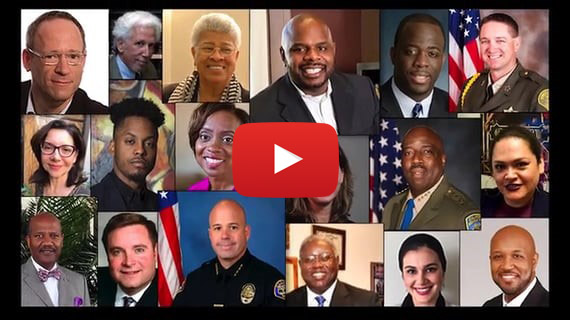
The 2018 report was accompanied by a video that illustrates the purpose of the RIPA Board – including comments from members of the Board and the public on the need for the Board – and highlights the work of the Board.